A board of work
The Work tab — writing down everything you have thought of, deciding what is ready, and letting the builder take them one at a time.
The Work tab. A place to put everything you have thought of, so that asking for things one at a time in the conversation is not the only way to work.
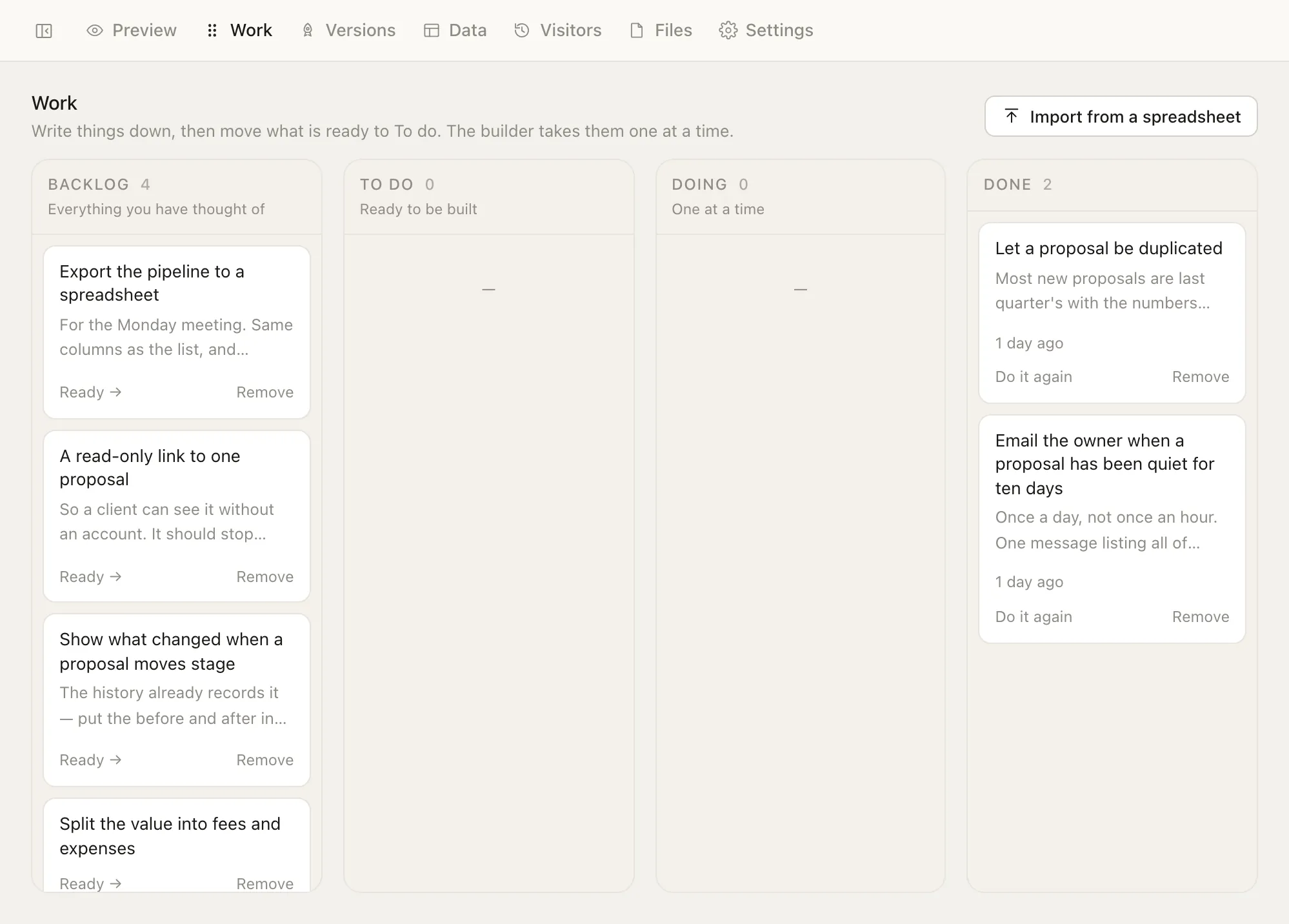
Four columns, and two of them are yours#
| Column | Whose |
|---|---|
| Backlog | Yours. Everything you have thought of. |
| To do | Yours. What is ready to be built. |
| Doing | The builder's. One card at a time. |
| Done | The builder's. What it finished, and what failed. |
You move cards between Backlog and To do. The builder takes the top card of To do, moves it to Doing while it works, and puts it in Done when the build has finished.
Neither side reaches into the other's columns. That is what makes the board worth having rather than a list of instructions in a chat: when a card is in Doing it has been handed over, and when it is in Backlog nothing is going to happen to it until you say so.
Writing a card down#
At the bottom of the backlog: Add a card. Type what needs doing and press Enter.
The composer stays open. A board is filled in a burst of six thoughts, and having to reopen something between them is where the fourth one gets lost. Press Esc when you are done.
A card asks for a title and nothing else. Open it afterwards to add the detail — what it is for, what it must not change, what finished looks like. That detail is what the builder is given when it picks the card up, so it is worth writing for anything that is not obvious.
Deciding something is ready#
Press Ready → on a card, or drag it into To do.
This is a separate act from writing the card down, deliberately. Everything starts in the backlog — including a card you added meaning it to be next — because collapsing the two is how a half-written thought gets built.
Once a card is in To do the builder will get to it on its own. Nothing else is needed from you.
One at a time#
The builder takes one card, finishes it, and takes the next.
This is not a queue waiting to be made faster. Two builds in one application share the same files on disk and the same running copy; the second would be reading files the first is halfway through writing. The result is not two changes in half the time, it is two half-finished changes and no way to tell which one broke what.
When one fails#
It goes to Done, marked, with what went wrong on the card. Press Do it again to put it back in the backlog — where you can edit it first, which is usually what a failed card needs. See When a build fails.
Bringing in a spreadsheet you already have#
Most teams arrive with the list already written down somewhere. Press Import
from a spreadsheet at the top of the board and drop in a .csv, .xlsx or
.ods file.
It looks for a Title column and a Detail column. Any heading that means the same thing works — Task, Name, Summary, Description, Notes, Acceptance criteria. If it cannot find a heading it recognises, it reads the first column as the tasks, so a bare one-column list works as it is.
The dialog has an example .xlsx and an example .csv to download if you would
rather start from the shape it expects.
Everything lands in the backlog, whatever a status column in the file says. Cards in To do are picked up and built without anybody pressing anything, and an import that landed there would start a build for every row of a file nobody had read line by line.
Importing the same file twice adds nothing: a title already on the board is skipped. So fixing three rows and uploading again gives you three cards, not a second copy of everything. Afterwards the dialog tells you what it did — how many were added, how many were already there, and which columns it read.
When to use the board and when to use the conversation#
The conversation is better for anything you want to watch, correct and steer — which is most of building an application.
The board is better when you already know a handful of things that need doing and do not want to sit with each one: write them down, mark two of them ready, and come back later. It is also the honest answer to what is left, which a conversation is not.
Next#
- Watching a build — what happens once a card is picked up.
- Changing your mind — correcting something that was built.